California Physician Home Loans

California Physician Home Loans Built for Markets Where Conventional Lending Falls Short

In Los Angeles, San Francisco, and San Diego, most physician purchases require a financing strategy—not just a preapproval.

California's home prices put most physicians in jumbo territory before their first attending paycheck arrives. Traditional lenders often miss the documentation complexity that comes with a physician's career stage. NEO reviews your full financial picture before you start searching—so you know where you stand and which programs are actually available to you.

Get Your California Physician Mortgage Strategy See why physicians get declined
Strategy before preapproval Physician-focused underwriting Quick answers, no runaround
Other banks said no. Complex income approved. — The Norton Family in front of their new home
Physician exclusive
100%
financing
no down payment

Now offering up to $3,000,000 in financing — including zero down on loans up to $2M, with no mortgage insurance.

See if you qualify

The paradox

The problem isn't that physicians are weak borrowers. It's that physicians are complex on paper.

Student loans
Residency transitions
Fellowship programs
Future income
Employment contracts
Practice ownership
1099 compensation
Jumbo financing

These factors create mortgage land mines that many lenders don't identify until after you've started house hunting, submitted an offer, or committed earnest money. Our process begins with a strategy-first review designed to uncover concerns and create a clear path forward.

Why physicians get declined

Why California physicians get declined for home loans.

You have strong earning potential and professional stability. But underwriting evaluates how your income, assets, liabilities, and documentation fit the guidelines — and that's where physicians run into trouble.

01

Student Loan Calculations

IDR plans, deferred loans, and large balances are calculated differently by program. The wrong calculation can significantly reduce purchasing power.

02

Employment Contract Issues

A signed contract doesn’t automatically qualify as income. Contract language, start dates, and contingencies all matter.

03

Residency & Fellowship Transitions

Moving between programs, hospitals, or cities creates qualification challenges traditional lenders rarely encounter.

04

Future Income Challenges

Many physicians buy a home before the first paycheck. The income is real — the challenge is documenting it correctly.

05

Jumbo Loan Requirements

Many physician purchases fall into jumbo financing, where underwriting standards become more restrictive.

06

Weak Preapprovals

Automated or lightly reviewed approvals often fail to identify underwriting concerns until much later in the process.
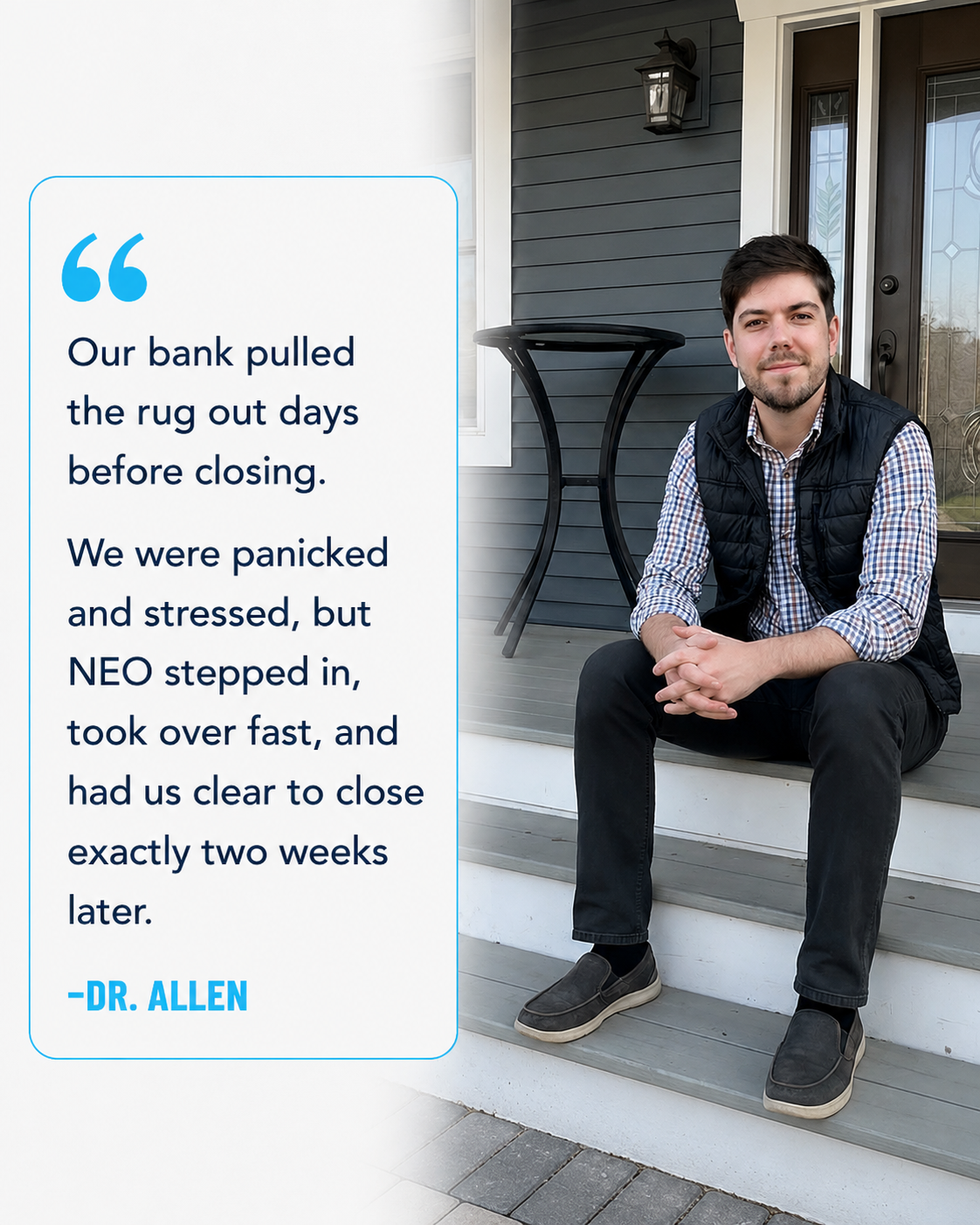
Testimonial: Our bank pulled the rug out days before closing. NEO stepped in and had us clear to close two weeks later. — Dr. Allen

Our review process

Most mortgage problems start long before underwriting.

They start when potential issues go undiscovered. That's why our process begins with a physician-focused strategy review.

1

Review Your Financial Profile

We evaluate income, student loans, assets, employment contracts, credit, and documentation.

2

Identify Potential Underwriting Risks

We look for issues that could create challenges later in the process.

3

Evaluate Available Loan Options

Different programs treat physician income, student loans, and contracts differently.

4

Build a Mortgage Strategy

You get a clearer understanding of your options and next steps before making major housing decisions.

The goal is simple: help you move forward with confidence before you make an offer, relocate, or commit to a purchase.

Who we help

California physician home loan programs for every career stage.
PhysiciansResident PhysiciansFellowsDentistsVeterinariansCRNAsPhysician AssistantsNurse PractitionersPharmacistsPractice OwnersIndependent Contractors1099 PhysiciansHigh-Income Professionals

Resident Physician Home Loans

Many residents assume student loan debt automatically prevents homeownership. That is not always true. Depending on your situation, contract status, loan program, and student loan structure, there may be options available. We help residents understand qualification strategies before they begin house hunting.

Evaluate my options →
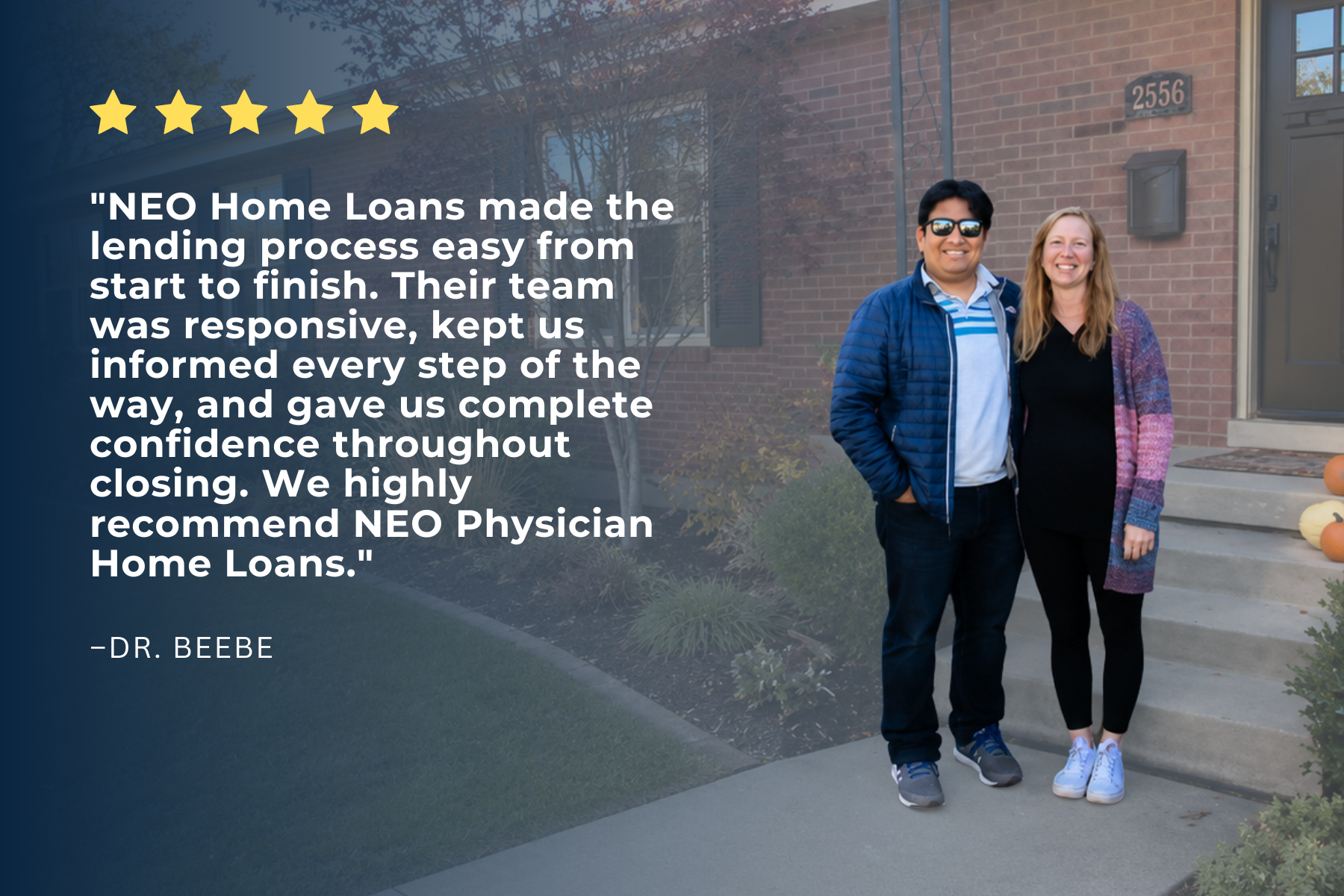
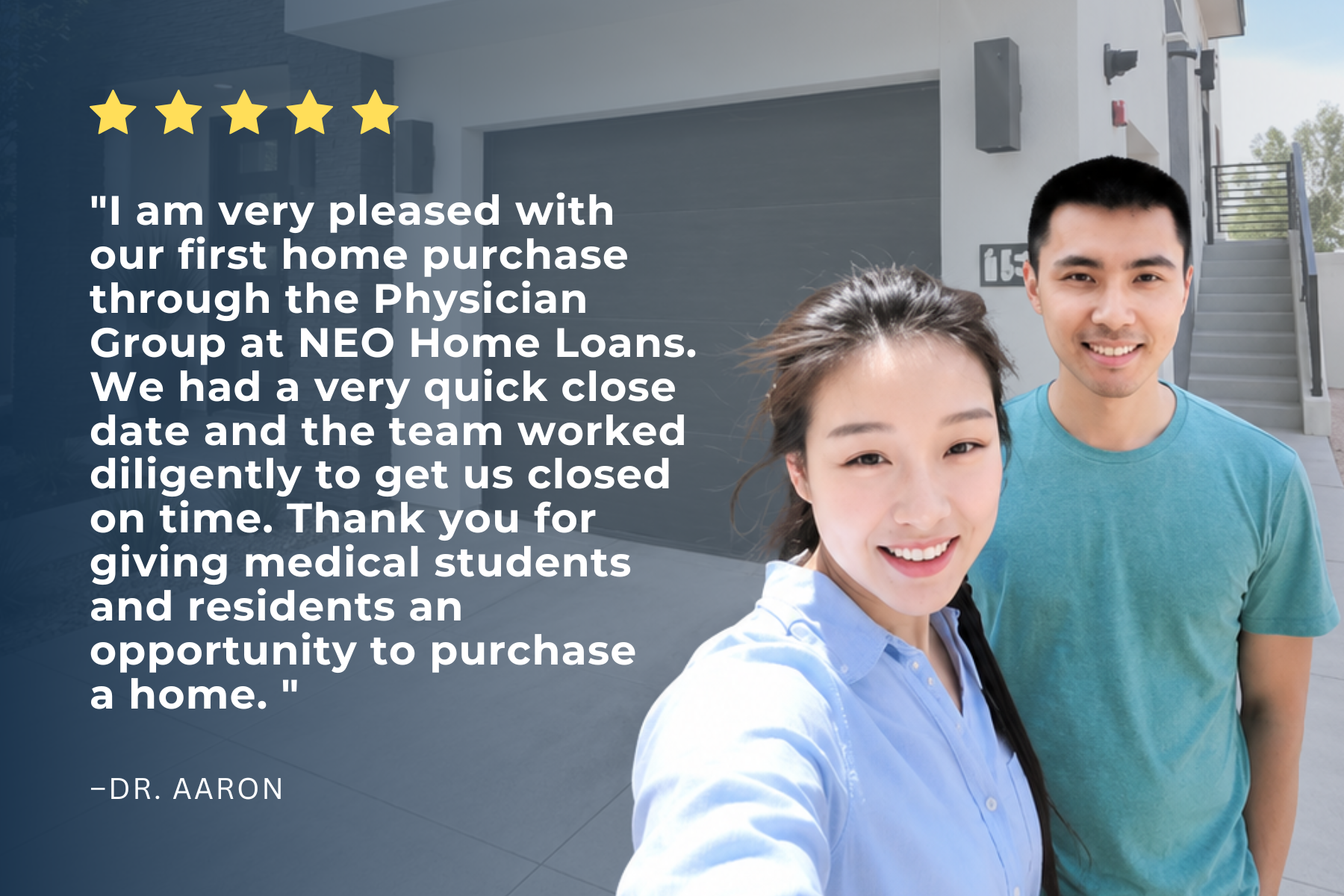
Five-star review from Dr. Aaron: very pleased with our first home purchase through the Physician Group at NEO Home Loans.

Program details

What the physician loan program offers.

Financing tiers

100% financing
up to $2,000,000
90% financing
up to $3,000,000

Loan amounts above reflect program maximums by financing level.

Program highlights

No private mortgage insurance
Gift funds acceptable
Close prior to employment start date
Flexible with student loan debt
1099 income with a guaranteed salary accepted
Hourly rate with stated hours accepted

Student loans

The most misunderstood part of physician qualification.

The way student loans are calculated can significantly impact purchasing power. Understanding the answers before applying helps prevent surprises later.

Q How do student loans affect mortgage approval?
+
Student loans factor into your debt-to-income ratio — the monthly payment used in that calculation depends on your repayment plan and the loan program you apply under. Some physician mortgage programs use your actual IBR or IDR payment. Others apply 0.5–1% of your total balance monthly regardless of what you currently pay. The difference can meaningfully change how much home you qualify for.
Q Can deferred student loans impact qualification?
+
Yes. Even loans in deferment count under most programs — lenders apply a percentage of the total balance as an assumed monthly payment rather than using $0. Physician-specific loan programs often treat deferred loans more favorably than conventional guidelines do, but the rules vary. Knowing exactly how your deferred balance is treated before you apply prevents surprises at underwriting.
Q How are IDR and IBR payments calculated for mortgage approval?
+
Income-Driven Repayment and Income-Based Repayment payments are set as a percentage of your discretionary income, which can result in a very low or even $0 monthly payment. Many physician loan programs will use your actual documented IDR/IBR payment in the DTI calculation — which significantly improves qualifying power compared to programs that use a percentage of the balance. Correct documentation of the payment amount is what makes this work.
Q Can I qualify with significant medical school debt?
+
Yes — physicians with substantial loan balances qualify regularly. The key variable is which program you use and how it treats your balance. A $400K balance at 1% monthly adds $4,000 to DTI. That same balance under a program using your $200 IBR payment adds only $200. Selecting the right program for your specific loan situation is often the difference between qualifying comfortably and not qualifying at all.
Q Which loan programs treat physician student loans differently?
+
Physician-specific mortgage programs — distinct from conventional, FHA, or VA loans — are designed to accommodate high student loan balances. Depending on the program, they may accept your actual IBR/IDR payment, exclude deferred loans from DTI entirely, or apply a lower percentage of the balance than conventional guidelines require. The right program depends on your loan structure, repayment plan, and purchase parameters — which is why reviewing this before you select a program matters.

Relocating to California

Moving for residency, fellowship, or a new attending role?

Understanding your mortgage options before relocating creates a smoother transition. We regularly assist medical professionals across the state.

Areas we serve

Los AngelesSan FranciscoSan DiegoSacramentoSan JoseIrvinePasadenaLong BeachOaklandPalo AltoSanta MonicaRiversideFresnoAnaheimBakersfield

Health systems we know

UCSF Medical Center
Cedars-Sinai Medical Center
UCLA Health
UC San Diego Health
Stanford Health Care

UCSF, Stanford, or UCLA resident entering the Bay Area or LA market?

California residency programs sit inside some of the most expensive housing markets on earth. A resident buying in San Francisco or Westwood isn't making a small financial decision — they're making one that needs the same pre-underwriting rigor as any complex jumbo file.

New attending whose salary doesn't yet reflect California income tax?

California's state income tax is among the highest in the country, and it affects your actual take-home significantly. If your approval was calculated on gross income without accounting for California's tax load, your real monthly capacity may be lower than the preapproval letter implies.

Buying in the Bay Area, LA, or San Diego where prices routinely exceed $1.5M?

Super-jumbo territory in California isn't a luxury scenario — it's the entry point for many markets. Physician loan programs have distinct guidelines at the $1M, $1.5M, and $2M+ tiers, and knowing where your purchase price lands before you shop changes which programs are available to you.

Medical practice owner or partnership-track physician in California?

California's physician community includes a large number of group-practice partners and independent contractors whose income runs through K-1s, business returns, and multi-entity structures. That documentation path is navigable — but only if it's reviewed and prepared in advance.

The basics

What is a California physician home loan?

California is the hardest physician mortgage market in the country — not because physicians aren't well-paid, but because home prices routinely outpace even physician-level income. In the Bay Area, a physician with $400K in annual income buying a $2M home needs a mortgage program that accounts for their student loan balance, their relatively recent employment contract, and a loan amount that far exceeds conventional limits. Physician loan programs in California frequently extend into jumbo and super-jumbo territory, and the underwriting standards at those tiers differ meaningfully from conforming guidelines.

What makes California unique for physician borrowers is the convergence of multiple risk factors at once: high loan amounts that trigger jumbo review, state income tax that reduces take-home relative to gross, student loan balances that affect DTI under some programs, and a competitive market that punishes slow or uncertain buyers. Getting approved isn't the challenge for most California physicians — getting approved accurately, with an offer that can close quickly in a competitive multiple-offer situation, is where the strategy matters.

Why physicians choose us

Why California physicians choose NEO.

Strategy Before Preapproval

Many lenders issue preapprovals before reviewing the details that matter. We believe clarity should come before commitment.

Physician-Focused Expertise

Medical professionals face mortgage scenarios that traditional lenders rarely encounter.

Proactive Underwriting Review

We work to identify potential concerns before they become closing delays or loan denials.

Student Loan Strategy

Student loans are one of the most common reasons physicians encounter qualification challenges.

Contract-Based Guidance

Employment contracts, future income, and start dates often require specialized review.

Relocation Experience

We help coordinate contracts, start dates, housing timelines, and financing considerations.

Get started

See what you qualify for.

Tell us a little about your situation and a California physician loan specialist will review your options with you — strategy first, before you make an offer.

By submitting this form, you agree to our privacy policy and consent to receive communications.

FAQ

Frequently asked questions

Why is getting a physician home loan in California harder than other states? +
Because multiple risk factors converge at once: loan amounts that routinely exceed conforming limits, state income tax that reduces take-home compared to gross, student loan balances that affect DTI calculations, and competitive markets where a weak preapproval can cost you the home. Each factor alone is manageable — together they require careful construction before you shop.
How does California's state income tax affect physician mortgage approval? +
California has one of the highest marginal income tax rates in the country. Most lenders calculate approval on gross income, but your real monthly capacity is based on take-home after federal and state taxes. A physician earning $450K gross in California takes home significantly less than the same physician in Texas or Florida — and that difference affects how much home you can realistically afford without stretching DTI.
Do California physician home loans go up to $2M or higher? +
Yes — several physician loan programs extend into super-jumbo territory, which is frequently necessary in Bay Area, LA, and coastal San Diego markets. The guidelines, reserve requirements, and documentation thresholds at $1.5M+ are meaningfully different from standard jumbo underwriting, and knowing those thresholds before you shop changes your search parameters.
Can a UCSF or Stanford resident buy a home in the Bay Area? +
Some programs may be available for residents, though the Bay Area presents a genuine challenge: home prices in San Francisco and the Peninsula regularly exceed $1.5M even for modest properties. A resident buying in this market needs realistic guidance on which programs are available at their income level, not just approval encouragement.
Can physicians relocating to California get approved before they start? +
Often yes, but California's income tax structure means the income documentation picture changes when you arrive. Relocating from a no-income-tax state to California requires adjusting income expectations for take-home calculations — a detail that catches some borrowers off guard at underwriting.
How do student loans affect physician mortgage approval in California specifically? +
In California's high-price markets, student loan balances interact with already-stretched DTI more aggressively than in lower-cost states. A $300K student loan balance treated at 0.5% monthly payment adds $1,500/month to DTI — significant when you're also financing a $1.8M purchase. Which program you use, and how your loans are structured, has a real impact on what you can buy.
Is a preapproval letter enough to compete in the Bay Area or Irvine? +
In California's most competitive markets, a standard preapproval is often the minimum floor. Sellers in multiple-offer situations favor buyers with strong loan commitment letters, documented reserves, and clean underwriting. A deeper file review before you shop strengthens every offer you make.
Can California medical practice owners and K-1 income physicians qualify? +
Yes. California has a large partnership-structure and group-practice physician community. K-1 income, business distributions, and multi-year income averaging are all workable — but they require documentation review before application, not last-minute submission to an underwriter.
What are the most common reasons California physicians are declined? +
High loan amounts that exceed program limits, student loans that push DTI over threshold, future income from a contract that hasn't started, insufficient reserves at the super-jumbo tier, and California income tax understated in gross-income-only approvals are the most common issues we see.

Get clarity first

You are not a weak borrower. You're a complex one.

The right strategy helps you identify potential mortgage land mines and move forward with confidence — before you make an offer, before you relocate, before underwriting discovers a problem.

Schedule Your Strategy Call Talk With a Loan Specialist

Serving physicians and medical professionals throughout California.